
MVP Portfolio
A collection of GenAI systems built to explore reliable architectures, async workflows, and AI infrastructure patterns.
Ship ad creatives faster—without trading off brand consistency
An AI pipeline that turns campaign inputs into ready-to-run video ad variants: scripts, voice, avatars, and reliable async rendering.
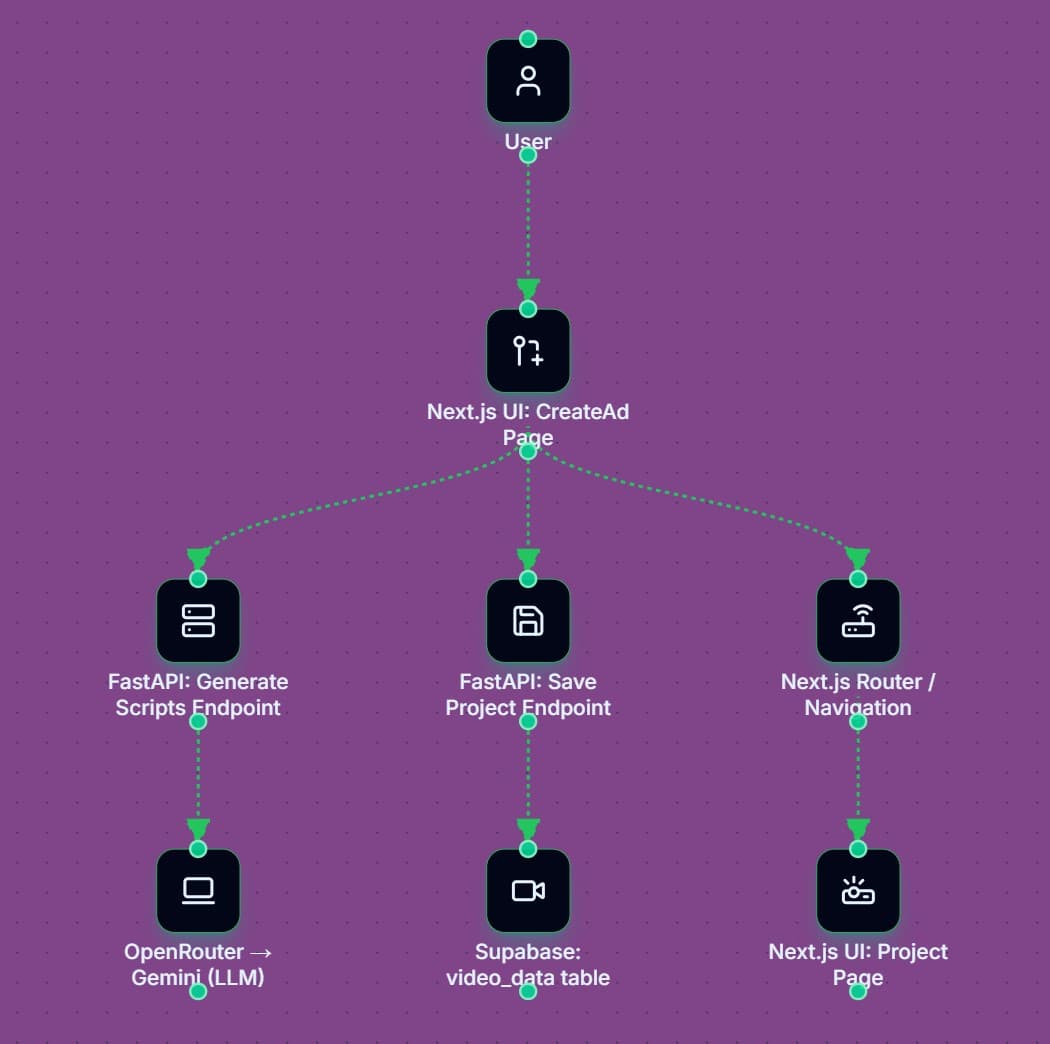
Queue design, orchestration, and reliability decisions—end to end.
Production stack (grouped by architecture)
A stable default stack for shipping GenAI products: clear boundaries, predictable orchestration, and operational maturity.
Frontend
Product UI + rendering pipelines.
Backend
APIs, orchestration, background work.
AI / Media
LLMs, agents, voice, avatars, video.
View stack (9)
Infrastructure
Auth + data + deployment primitives.
Documentation in progress
These systems are built and tested; documentation and case studies are being prepared.
Perplexity-style AI Research Tool
Full-stack AI research workspace for iterative investigations.
Agentic routing with web search, SSE streaming, and session persistence.
AI Short Video Generator
Short-form video pipeline from prompt to rendered MP4.
FastAPI orchestrates generation pipelines with Remotion workers for async rendering.
YouTube Analytics & Growth Tool
Creator analytics and workflow tool for content optimization.
Multi-step analysis workflows using Gemini and YouTube Data API.
AI Logo Maker
Branding tool for generating and iterating logo variations.
LangGraph workflows for generation loops with persistent user history.
AI Interview & Scoring Platform
Voice interview platform for structured candidate evaluation.
Real-time voice sessions with stateful orchestration and scoring dashboards.
AI Medical Voice Agent (Prototype)
Voice-first medical intake assistant for triage and scheduling.
Real-time clinical conversations with structured data extraction.
Engineering approach
Building AI systems that behave predictably under real workloads—especially async jobs, streaming, and orchestration.
Reliability
Async workflows with retries, idempotency, and explicit failure handling.
Observability
Structured logs, traceable job state, and monitoring for long-running tasks.
Production constraints
Authentication boundaries, data handling, and predictable orchestration.
How I approach AI system development
A structured engineering process for building AI systems involving orchestration, async workflows, and production constraints.
- 1
Problem framing & system design
Define user workflows, system boundaries, and architecture before implementation. Establish data models and identify risks for complex pipelines.
Focus areas
Architecture designData model and API structureWorkflow and orchestration planningRisk identification for complex pipelines - 2
Implementation & system integration
Build the core system loop integrating orchestration, persistence, and user-facing workflows. Connect backend services with the UI layer.
Focus areas
Agent or workflow orchestrationJob state and persistenceBackend services and APIsUser interface and system interactions - 3
Evaluation & iteration
Improve reliability and usability through testing, monitoring, and iterative refinement based on system behavior and output quality.
Focus areas
System monitoring and loggingPerformance improvementsEvaluation of model outputsIterative product improvements